Is Your Elm Tree at Risk? A Guide to Dutch Elm Disease
- Kevin Lester

- 7 days ago
- 3 min read
Have you noticed that your elm tree appears to be struggling? As we enter the summer months, you may see a drastic decline in its health and appearance. This is likely due to Dutch Elm Disease, a serious condition that poses a significant threat to your beloved elms.

What is Dutch Elm Disease?
Dutch Elm Disease (DED) is a vascular wilt disease caused by a fungus. The fungus invades the tree's water transportation system, and in response, the tree plugs its own vessels, causing the tree canopy to die back.
Multiple species of this fungus have been identified, but it is important to know that elm bark beetles are mainly responsible for its spread. These beetles breed in the bark of dying and dead elm trees that are often infected with the fungus. As adults, they feed on the young twigs of elm trees and can spread fungal spores from their bodies to infect healthy trees.

The fungus can also spread through the root system of infected trees to other healthy elms nearby. This is because neighboring elm trees form root grafts on neighboring trees to allow water and nutrients to flow from one tree to the other. Unfortunately, this also allows the fungus to spread from one tree to another too. Root grafts commonly occur between neighboring trees of the same species, but they can also occur between neighboring trees from different species.
Trees affected by Dutch Elm Disease
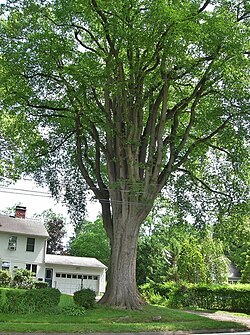
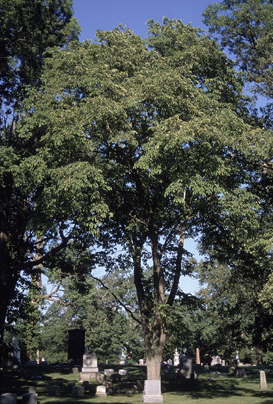
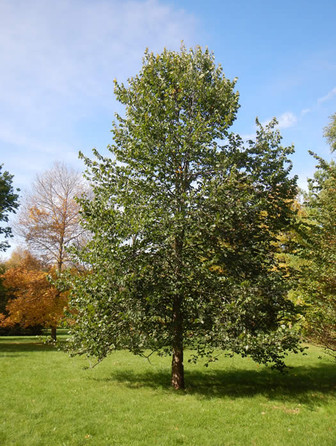
All native American Elms are susceptible to the disease, including:
American Elm
Some varieties of American Elm may have a high tolerance to the disease; these are often marketed as DED-resistant
Slippery Elm
Rock Elm



What to Look For
Symptoms first arrive early to mid-summer when the leaves at the tips of infected elm branches turn yellow and begin to wilt. The affected shoots gradually die back, and as the disease progresses in an individual tree, more of the leaves in the canopy turn from yellow to brown.
A certified arborist knows other ways to spot and diagnose Dutch Elm Disease, such as examining the wood beneath the bark. Healthy wood will be free from blemishes, while infected wood is marked with dark brown streaks caused by the tree's vascular system plugging itself up to prevent the fungus from spreading.
If the fungal infection goes unnoticed or untreated, it will eventually kill the elm tree and possibly spread the infection to other elms in the surrounding area. It is important to know the warning signs and how to take appropriate action.
Management and Prevention
It is important to note that there is no known cure for Dutch Elm Disease. Once a tree is severely infected, the only response is to completely remove the tree from the property to protect other elms in the area and reduce any potential damage from a dead tree. However, if caught early enough, a certified arborist may be able to prune the infected branches before the fungus reaches the stem of the tree.
How an arborist can help
A certified arborist may be able to help you prevent Dutch Elm Disease through a variety of methods, such as:
Fungicide injections
Preventive fungicide injections can be used to protect trees from infection by elm bark beetles.
Depending on the chosen fungicide, the treatment must be repeated every 1-3 years.
Fungicide injections are not very effective in preventing infection by root grafts. Because of this, it is important that all trees in an area be treated and root grafts severed when removing an infected tree.
Reducing the number of breeding sites for elm bark beetles
This can be achieved by removing dead or dying elm wood with intact bark.
Pruning should only occur during the tree's dormant season, which runs from October through March. This is because the beetles that carry the fungus are inactive during the colder months.
If tree removal is your only option, a certified arborist can help you pick DED-resistant or tolerant elm species for replacements, such as
'Princeton' American Elm
'Valley Forge' American Elm
Chinese Elm
'Accolade' Elm
If you notice an elm tree in your yard showing symptoms of Dutch Elm Disease, do not wait; click the link below to fill out a form on our website. One of our Certified or Master Arborists will contact you shortly to schedule a visit for a professional tree assessment.